
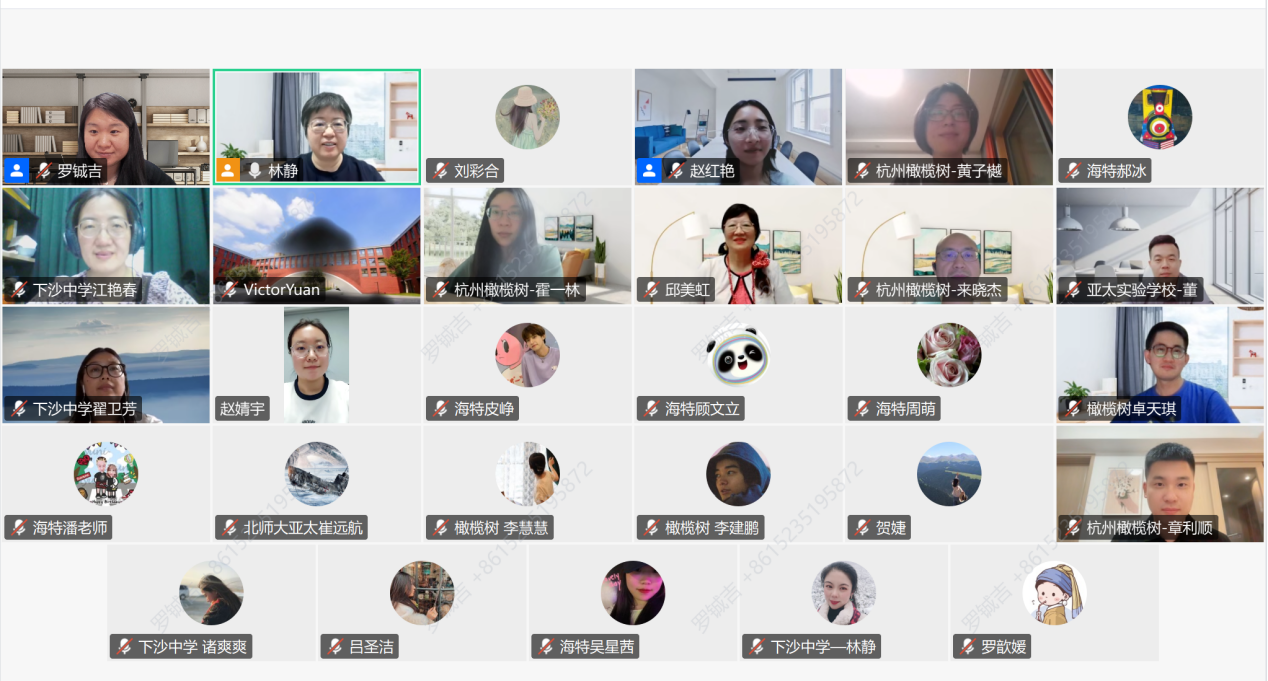
为深入推进社会性科学议题学习(SSI-L)项目实施,探索社会性科学推理(SSR)与社会性科学建模等跨学科实践在教学实践中的落地路径,切实提升学生科学素养与创新实践能力,2025 年 6 月 23 日晚,北京师范大学 SSI-L 项目负责人林静携项目团队成员,以及北京师范大学亚太实验学校、北京石景山海特花园小学、杭州橄榄树学校、杭州下沙中学四所合作校 SSI-L 项目组教师,齐聚云端开展深度研讨。本次会议特别邀请国际科学教育领域知名专家、台湾师范大学邱美虹教授出席指导。
会议伊始,北师大 SSI-L 项目组成员罗铖吉与赵红艳分别就社会性科学推理与科学建模的核心理论及教学实践进行阐释。罗铖吉指出,社会性科学推理(SSR)需整合多学科知识、伦理道德、情感体验等多维要素,以解决开放复杂的真实议题。赵红艳结合“全球变暖机制” 建模教学实践,提出建模教学需从 “确定知识” 转向 “问题驱动”,强调通过营造开放协作的课堂氛围,引导学生在建模实践中深化科学理解,并呈现了五年级、七年级学生模型迭代的典型案例,直观展现学生科学建模的发展轨迹。
接着,杭州橄榄树学校黄子樾分享了选题历程,团队教师基于 “本土化、争议性适中、可操作” 原则,从校园电子产品使用、流浪猫管理等候选议题中筛选出“塑料治理”议题,以五星图为顶层设计框架,从科学、政策、伦理等维度整体架构,设计驱动性问题与子驱动性问题,为社会性科学议题跨学科教学提供实施路径。北京石景山海特花园小学则围绕 “吃糖与健康” 的议题,阐述了从糖分代谢机制、情绪与吃糖关联,与科学、心理等等多元视角架构五星图框架。随后,四校合作校教师围绕议题选择适配性、学科融合策略及与课标结合等关键问题展开激烈讨论,形成诸多建设性共识。
北师大 SSI-L 项目负责人林静针对各校课程设计提出建议。针对共性问题,她指出社会性科学议题跨学科教学需以现实问题为切入点,系统梳理涉及的各学科课标要求,通过学科协同研究来构建议题解决的逻辑结构,建立驱动性问题链,实现SSI-L教学与学科课标目标及要求的深度契合。同时强调四校应构建发展共同体,在议题设计与教学实践中共享经验,协同创新,推进社会性科学议题跨学科教学落地实施。
特邀专家邱美虹教授高度肯定了各校的SSI-L实践探索,强调议题设计需链接课标,紧扣课标,注重“可操作性” 与 “科学性” 结合。她建议各校在五星图框架中应强化维度之间的逻辑关联,例如减塑治理中科学技术与政策伦理两个方面的交互影响,同时提出评价应兼顾形成性评量与终结性评量,确保SSI跨学科教学目标可测可评。
此次会议,SSI-L项目四所合作校教师齐聚云端,围绕议题选题、社会性科学推理(SSR)、科学建模等展开深度研讨,开启了各校社会性科学议题学习项目进程的新篇章。教育之路,道阻且长,行则将至。展望未来,四校同仁将以此次联动为契机,携手耕耘,持续优化议题设计,聚焦学生科学素养发展,推动社会性科学议题这一跨学科主题在课堂教学中落地生根,为培养兼具科学素养与社会责任感的时代新人探索创新路径。
To deeply advance the implementation of the Socioscientific Issues-based Learning (SSI-L) Project, explore the practical application of interdisciplinary practices such as socioscientific reasoning (SSR) and socioscientific modeling (SSM) in teaching, and effectively enhance students’ scientific literacy and innovative practice capabilities, on the evening of June 23, 2025, Lin Jing, the project leader of the Beijing Normal University SSI-L Project, along with project team members and teachers from the SSI-L project teams of four partner schools—Asia-Pacific Experimental School of Beijing Normal University, Beijing Shijingshan Haite Garden Primary School, Hangzhou Olive Tree School, and Hangzhou Xiasha Middle School—gathered online for an in-depth seminar. The meeting specially invited Professor Chiu Mei-Hung, a renowned expert in international science education from Taiwan Normal University, to provide guidance.
At the start of the meeting, Luo Chengji and Zhao Hongyan, team members of the Beijing Normal University SSI-L Project, respectively elucidated the core theories and teaching practices of socioscientific reasoning and scientific modeling. Luo Chengji pointed out that SSR requires the integration of multidisciplinary knowledge, ethical considerations, and emotional experiences to address open and complex real-world issues. Zhao Hongyan, drawing on the teaching practice of modeling “global warming mechanisms,” proposed that modeling instruction should shift from “fixed knowledge” to “problem-driven” approaches, emphasizing the creation of an open and collaborative classroom atmosphere to guide students in deepening scientific understanding through modeling practices. She presented typical cases of model iteration by fifth- and seventh-grade students, vividly demonstrating the developmental trajectory of students’ scientific modeling.
Next, Huang Ziyue from Hangzhou Olive Tree School shared the issue selection process. Based on the principles of “localization, moderate controversy, and operability,” the teacher team screened candidate issues such as campus electronic device use and stray cat management, and ultimately selected the “plastic governance” issue. Using a five-star chart as the top-level design framework, they structured the issue holistically from dimensions such as science, policy, and ethics, and designed driving questions and sub-driving questions to provide an implementation pathway for interdisciplinary SSI teaching. Beijing Shijingshan Haite Garden Primary School focused on the “sugar and health” issue, elaborating on the construction of a five-star chart framework from diverse perspectives, including sugar metabolism mechanisms, the connection between emotions and sugar consumption, and the intersection of science and psychology. Subsequently, teachers from the four partner schools engaged in intense discussions on key issues such as the suitability of issue selection, interdisciplinary integration strategies, and alignment with curriculum standards, and achieved various constructive consensuses.
Lin Jing, leader of Beijing Normal University SSI-L Project, offered suggestions on the curriculum designs of each school. Addressing common issues, she noted that interdisciplinary teaching of SSI should take real-world problems as entry points, systematically align with the curriculum standards of relevant disciplines, construct the logical structure for issue resolution through interdisciplinary collaborative research, and establish a chain of driving questions to achieve deep alignment between SSI-L teaching and the goals and requirements of curriculum standards. She also emphasized that the four schools should form a developmental community, sharing experiences and collaborating on innovation in issue design and teaching practices to advance the implementation of interdisciplinary SSI teaching.
Invited expert Professor Chiu Mei-Hung highly commended the SSI-L practice explorations of each school, emphasizing that issue design must align with and adhere to curriculum standards, balancing “operability” and “scientificity.” She suggested that schools strengthen the logical connections between dimensions in the five-star chart framework, such as the interactive impacts of science and technology and policy ethics in plastic governance, while proposing that evaluation should encompass both formative and summative assessments to ensure that interdisciplinary SSI teaching goals are measurable and evaluable.
This meeting brought together teachers from the four SSI-L partner schools online, engaging in in-depth discussions on issue selection, socioscientific reasoning, and scientific modeling. It marked a new chapter in the progress of each school’s SSI-L Project. The path of education is arduous and long, but progress will be achieved through action. Looking to the future, colleagues from the four schools will take this collaboration as an opportunity to work together, continuously optimize issue design, focus on the development of students’ scientific literacy, and promote the rooting and flourishing of the interdisciplinary SSI-L in classroom teaching, exploring innovative pathways for cultivating new-era individuals with both scientific literacy and social responsibility.