
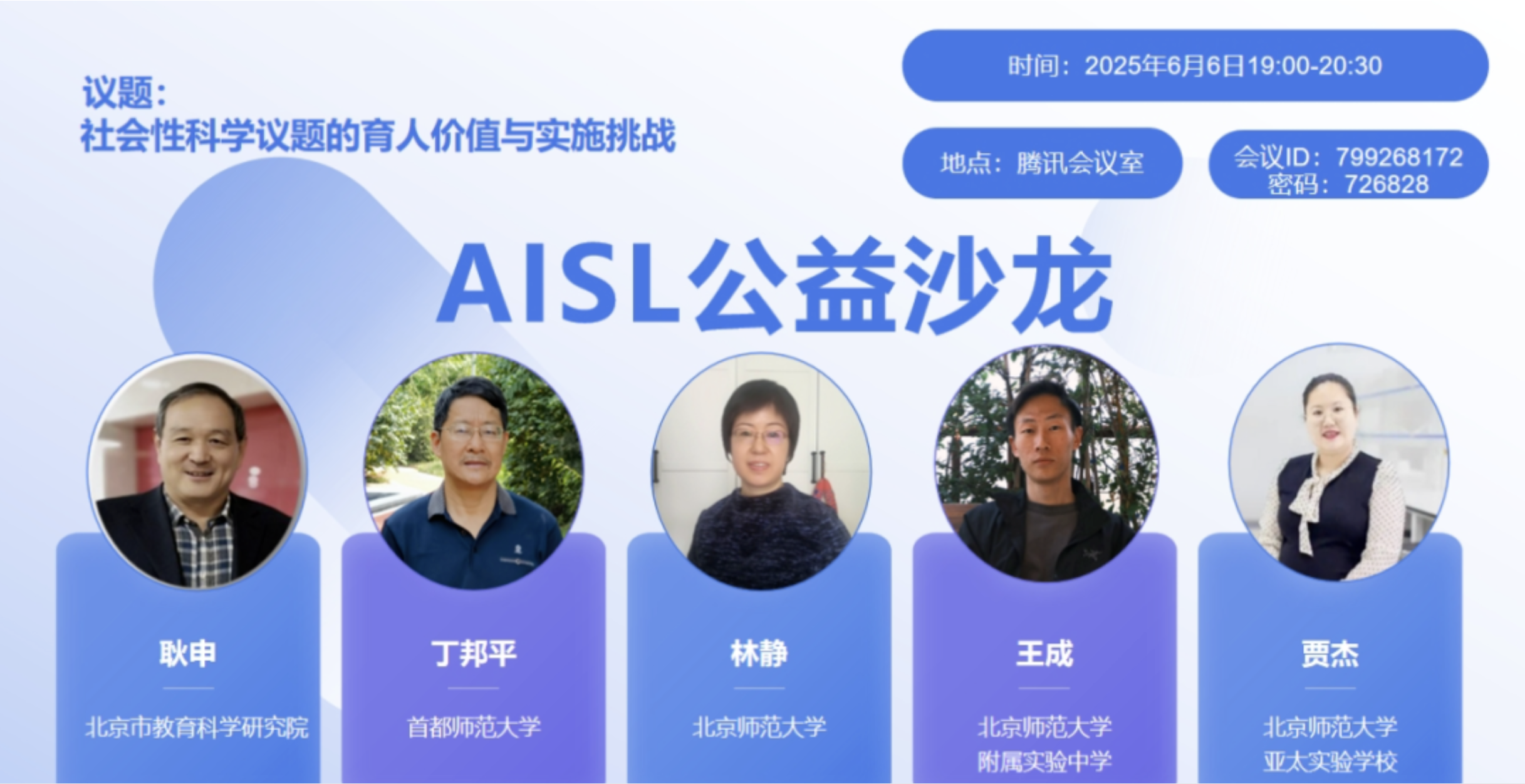
在标准答案盛行的教育环境中,一种探索“无标准答案”问题的课堂正引发科学教育深层变革。2025年6月6日,AISL公益沙龙汇聚北京市教育科学研究院耿申、首都师范大学丁邦平、北京师范大学林静等专家,北京师范大学附属实验中学王成、北京师范大学亚太实验学校贾杰等一线骨干教师深度探讨社会性科学议题(SSI)的育人价值。核心共识:SSI是融合科学素养与社会责任、落实“立德树人”根本任务的核心抓手。
一、 SSI本质:连接科学与社会现实的桥梁
耿申开宗明义:SSI是科技与社会伦理、经济、文化交织的复杂议题(如环保与发展的冲突、AI伦理挑战),具有开放性、结构不良性与无唯一解。林静强调其独特价值在于彰显了科学素养的第三层视角“科学的社会功能”——科技对人类社会上层建筑的深度重塑。王成指出,SSI区别于传统跨学科教学(如物理+化学分析新能源汽车),更聚焦“真实世界的结构性矛盾”。贾杰以小学课堂为例:当学生通过绘制“全球变暖成因”模型,经历结论被推翻的过程,实现在 “无解问题中像科学家一样思考”的学习经历。
二、 SSI育人价值:多维赋能未来公民
与会专家与教师从三重维度解析SSI激发的变革力量:
1. 锻造高阶思维与责任担当
SSI直击批判性思维与社会责任感培养(耿申),补足传统教育缺失的“非形式推理”能力(如辩论科技应用利弊)(丁邦平),引导学生理解科技伦理边界,成为 “担当民族复兴大任的未来公民”,服务于立德树人根本任务(林静)。
2. 打破知识闭环,驱动学以致用
在疫情、雾霾等真实情境中,推动知识加工应用,转化为决策力(林静)。学生从“被动接受”转向“主动思辨”,如通过制定“低碳校园倡议”提升沟通与复杂问题解决能力(王成、贾杰)。
3. 撬动科学教育转型
SSI完美契合新课标“跨学科学习”要求(丁邦平)。以“雾霾治理”整合物理、化学、政治知识为例,推动 “从解题到解决问题”的跃迁,其激发的学生参与度(如辩论赛)正重塑课堂生态(林静)。
三、 SSI落地路径:小步实践与素养锚点
面对实施挑战,凝聚行动共识:教师需从“知识权威”转型为学生“共同探究者”。关键路径:
1. 议题贴近生活圈:小学用“北极熊家园危机”故事化教学(贾杰),中学从“校园垃圾分类”切入(林静);
2. 渐进式推进:耿申建议“每学期1-3个小议题”,王成提出“阶梯任务设计”(如初中生先绘图理解再数据分析);
3. 锚定素养评价:聚焦社会责任、高阶思维迁移及知识应用能力,强化学生自评与反思。
结语:回归本质,共探未来
林静呼吁:“放下对名词的纠结,回归教育本质——培养能驾驭不确定未来的学习者!”
本次沙龙是思想碰撞的起点,AISL将于后续系列活动中深入探索:
1. 国际SSI教育经验本土化
2. 小学到高中议题复杂度分级指南
3. SSI教学评价工具箱开发
诚邀全国教育同仁同行,共筑科学教育新生之路!
Making Science Education Come Alive: Socio-Scientific Issues—A Golden Key to Forging Future Citizens
In an educational system dominated by standard answers, a classroom model exploring “questions with no single standard answer” is driving profound reform in science education. On June 6, 2025, the AISL Public Salon brought together experts including Geng Shen from (Beijing Academy of Educational Sciences), Ding Bangping (Capital Normal University), and Lin Jing (Beijing Normal University), along with frontline backbone teachers such as Wang Cheng (Experimental High School Attached to Beijing Normal University) and Jia Jie (Asia-Pacific Experimental School of Beijing Normal University), for an in-depth discussion on the educational value of Socio-Scientific Issues (SSI). Core consensus was reached that SSI serves as a pivotal tool for integrating scientific literacy and social responsibility, aligning with the fundamental mission of fostering moral and intellectual development (立德树人, Lideshuren).
I. The Essence of SSI: Bridging Science and Societal Realities
Geng Shen framed SSI as complex issues where science intersects with ethics, economics, and culture (e.g., conflicts between environmental protection and economic development, AI ethics), characterized by open-endedness, ill-structured problems, and alternative solutions. Lin Jing highlighted its unique value in revealing the Vision III of scientific literacy—“the social function of science”—how science and technology reshape societal superstructures. Wang Cheng noted that SSI-L differs from traditional interdisciplinary approaches (e.g., analyzing vehicles through physics + chemistry) by focusing on “structural contradictions in the real world.” Jia Jie shared an elementary classroom example where students modeling “causes of global warming” experienced scientific thinking firsthand when their conclusions were challenged, embodying the essence of “thinking like scientists in unsolvable dilemmas.”
II. SSI’s Educational Value: Empowering Future Citizens
Experts and teachers identified three transformative dimensions of SSI:
1. Cultivating Critical Thinking & Civic Responsibility
SSI targets critical analysis and social accountability (Geng Shen), addressing gaps in traditional education like informal reasoning (e.g., debating the pros and cons of tech ethics) (Ding Bangping). It guides students in navigating ethical boundaries, becoming “future citizens capable of national rejuvenation” (Lin Jing).
2. Breaking Knowledge Silos, Enabling Real-World Application
In real-world contexts, such as pandemics or haze, SSI transforms knowledge into decision-making agency (Lin Jing). Students shift from passive reception to active deliberation, e.g., designing “low-carbon campus proposals” to hone communication and problem-solving skills (Wang Cheng, Jia Jie).
3. Catalyzing Science Education Reform
SSI perfectly aligns with China’s new curriculum standards for interdisciplinary learning (Ding Bangping). For instance, “smog mitigation” integrates physics, chemistry, and politicy knowledge, advancing from “solving item exercises” to “solving problems.” Its engagement boost (e.g., debates) is reshaping classrooms (Lin Jing).
III. Implementation Pathways: Incremental Steps & Competency Anchors
To overcome challenges, teachers must transition from “knowledge authorities” to “co-inquirers” with students. Actionable strategies emerged:
1. Localized Topics: Issues rooted in everyday life (e.g., use storytelling “polar bear habitat crisis” in elementary schools—Jia Jie, while “campus waste sorting” in secondary schools—Lin Jing).
2. Phased Progression: Geng Shen suggested “1–3 small issues per semester,” and Wang Cheng proposed “tiered tasks” (e.g., middle school students progress from data mapping to analysis).
3. Competency-Based Assessment: Focus on social responsibility, higher-order thinking, and knowledge application, strengthening student self-reflection.
Conclusion: Back to Basics, Co-Exploring the Future
Lin Jing urged, “Move beyond terminology and return to the essence of education—nurturing learners who thrive in an uncertain future!”
This salon marked a starting point. AISL’s upcoming initiatives will delve into:
1. Localizing international SSI education practices.
2. Graded SSI complexity guides (K-12).
3. SSI teaching evaluation toolkits.
We sincerely invite educators nationwide to join this journey—building a new path for science education!