
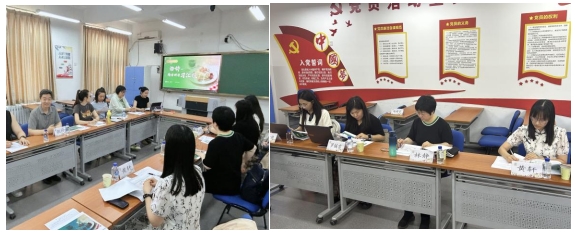
2025年7月6日下午,北京市石景山区海特花园小学围绕“糖与健康”开展社会性科学议题教学专题研讨。北京师范大学社会性科学议题学习(SSI-L)项目负责人林静、北京教育学院数学与科学教育学院黄瑄以及项目组成员罗铖吉、赵红艳出席会议。海特花园小学校长张岭全程参与指导,科研负责人顾文立主持并组织学校多学科教师团队,共同探讨社会性科学议题课程的设计。
聚焦“糖与健康”SSI课程设计
本次研讨以“吃糖与糖尿病”为切入点,各学科教师结合课程标准、围绕学科核心素养,探讨了关于议题教学的初步设计构想。在心理健康方面,郝冰指出情绪性吃糖行为,也就是吃糖对调节情绪影响的作用;语文方面,周萌提出如何“认识糖,描述糖”,即通过语言构建与运用培养学生的感知和描写能力;在美术方面,吕圣洁提出通过对糖纸包装设计的赏析从而提升学生审美与创造的感知和再加工;在数学方面,皮峥、吴兴茜提出通过收集每日家庭糖分摄入从而引导学生用数学的眼光观察世界。各学科教师以五星图为载体,通过跨学科融会贯通揭示议题内涵,构建学生对议题的立体认知、提升其多角度思考议题的能力。顾文立就课程设计提出关于议题如何更好落地的个人思考,即提供的数据可信且具有实际意义、需要研究或解决的问题确实存在。
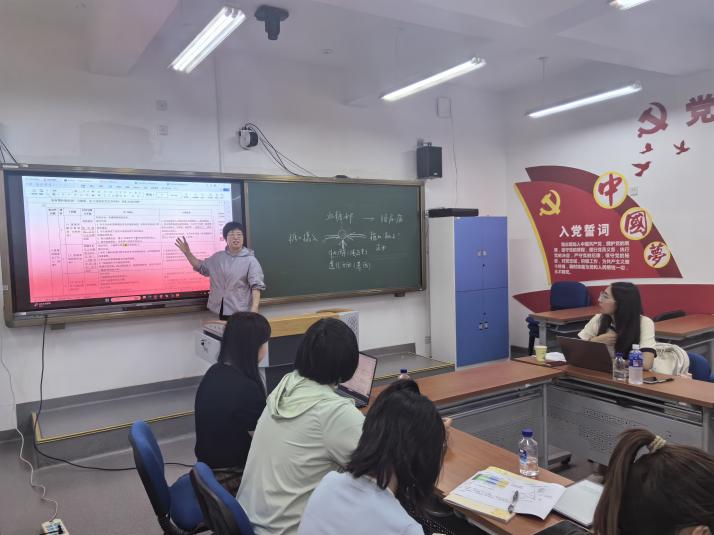
研讨过程中,黄瑄结合生物学科知识,譬如生物体的稳态与调节、饮食与运动会影响健康等知识,结合学情对本专题课程提出了具体建议。罗铖吉分享了旨在培养学生社会性科学推理能力的SSI教学的关键策略,赵红艳围绕科学建模教学进行教学流程的设计概述。随后,林静结合本校四、五年级学生的特点,规划了“吃糖多会引发糖尿病吗?”这一核心议题的教学顶层设计和系列驱动性问题。最后,与会人员围绕“糖与健康”SSI课程设计过程中的“资料呈现”、“过程性评价”等问题进行探讨交流。
持续推进项目落实
本次研讨会是海特花园小学探索SSI教育教学新理念的实践探索。张岭校长强调:“科研不是少数人的事,而是每位教师的成长路径。”教师团队将进一步关联课程标准、设计评价方案,努力将“建模思维”和“健康意识”教育融入学校特色课程中。期待这项以学生发展为中心的研究探索取得良好成效。
On the afternoon of July 6, 2025, Haite Garden Primary School in Shijingshan District, Beijing, held a thematic seminar on socioscientific issues (SSI) teaching centered on “Sugar and Health.” Lin Jing, the project leader of the Beijing Normal University Socioscientific Issues-based Learning (SSI-L) Project, Huang Xuan from the Mathematics and Science Education Department at Beijing Institute of Education, and Luo Chengji and Zhao Hongyan, the project team members, attended the meeting. Principal Zhang Ling of Haite Garden Primary School, Gu Wenli, the research coordinator of the school, presided over the seminar, and organized the school’s multidisciplinary teacher team to collectively explore socioscientific issues curriculum design.
Discussion on the “Sugar and Health” SSI Curriculum Design
This seminar took “Sugar Consumption and Diabetes” as the entry point. Teachers from various disciplines discussed preliminary design concepts for issue-based teaching, aligning with the national curriculum standards and focusing on their own disciplinary core competencies. In terms of mental health, Hao Bing highlighted emotional sugar consumption behavior, specifically the role of sugar consumption in regulating emotions. In Chinese language, Zhou Meng proposed “understanding sugar, describing sugar,” aiming to cultivate students’ perception and descriptive abilities through language construction and application. In art, Lü Shengjie suggested enhancing students’ aesthetic and creative perception and reprocessing through the appreciation of sugar packaging design. In mathematics, Pi Zheng and Wu Xingqian proposed guiding students to observe the world through a mathematical lens by collecting data on daily household sugar intake. Teachers across disciplines used a five-star chart as a framework, discussing the issue’s educational value through interdisciplinary integration, aiming to construct students’ multidimensional understanding of the issue and enhance their ability to think about it from multiple perspectives. Focused on curriculum design, Gu Wenli shared personal thoughts on how to implement the issue better, how to use credible and practical data, and genuine problems.
During the seminar, Huang Xuan integrated biological knowledge, including the body’s homeostasis and regulation, as well as the impact of diet and exercise on health, and provided specific suggestions for the thematic curriculum based on students’ learning conditions. Luo Chengji shared key strategies for SSI teaching aimed at cultivating students’ socioscientific reasoning abilities. Zhao Hongyan provided an overview of the teaching process design for scientific modeling instruction. Subsequently, Lin Jing, combined the characteristics of fourth- and fifth-grade students at the school, and outlined the top-level teaching design and a series of driving questions for the issue, “Does consuming too much sugar cause diabetes?” Finally, participants engaged in discussions and exchanges on issues such as “material presentation” and “formative assessment” in the “Sugar and Health” SSI curriculum design process.
Continuous Advancement of Project Implementation
This seminar represented a practical exploration by Haite Garden Primary School into new concepts of SSI education and teaching. Principal Zhang Ling emphasized: “Research is not the task of a few but a growth pathway for every teacher.” The teaching team will further align with curriculum standards, develop evaluation plans, and aim to integrate “modeling thinking” and “health awareness” education into the school’s unique curriculum. We look forward to this student-centered research exploration achieving positive results.